


In the fifth round of the UEFA Nations League A group stage, England will host Croatia. Ahead of the match, England striker Calvert-Lewin was interviewed by the media, discussing his feelings about playing for England, his competition with Kane, and his form at Leeds United.
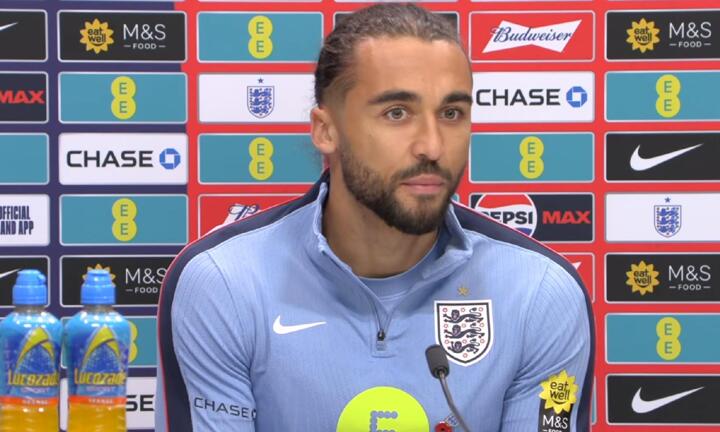
Second part of the interview
Lewin: Tuchel's demands for playing style are clear, which makes me understand my role and tasks
During the recent England training camps, there has been a lot of discussion about some players potentially being reluctant to play for England. The coach said at the last training camp that he had doubts about whether one or two players were willing to play for England. You made your senior England debut six years ago, and since then you've been through a lot, including injuries and the frustration of not being selected for England, but now you're back. How strong is your desire to play for England? How important is it to you still?
It means everything to me. As a child, I dreamed of playing for England and representing England. To be here now is something I am very proud of, and I am very grateful. When did I first have this experience? Six years ago. The long gap in between makes me cherish the opportunity to be here today even more.
One person who may have reduced your opportunities to play for England is Kane. He is expected to become England's all-time most capped player on Thursday. I imagine this might be a bit of a blow to you. However, how would you describe him? How important is he to English football?
His record speaks for itself. He is an outstanding player, the captain of England, and leads by example. I think he deserves all the accolades he is currently receiving. Personally, as a centre-forward, it's not easy to compete with him for that position. So I think that every time I come to an England training camp now, I have to be as prepared as possible. If the team needs me, I have to be ready to seize my opportunity.
I saw in a recent interview with you that you didn't always like the term "target man" in the past. Do you think that developing this aspect of your game has brought you back into the England squad? Do you like the term now?
Yes, I think so. I think with my current attributes and playing style, it does suit me to be a target man. Everyone can have their own interpretation of the term. But for me, as I play more and gain more experience, I've gradually learned to enjoy this role and do it better and better. So, people can call me whatever they want.
Following on from that, and also Rob's question earlier, because you have Kane ahead of you, it might be harder for you to get playing time. Do you need to develop these attributes, or improve other aspects of your game, in order to influence matches when you might not play the full 90 minutes?
As a striker, your role has different demands. When you're on the bench, you know you might need to make an impact on the game when you come on, depending on how the match progresses.
My characteristics, and a major reason why I'm in this squad, is probably that I can do different things when I come on, depending on the situation of the game. If we need a goal, I can come on and positively influence the game. But at the same time, if the team needs me to hold up the ball, or play more directly, my physicality is also suited to doing those things. This is also something I've gradually realized. Everyone in the team has different individual strengths, and that's why we're here.
Since you arrived at Elland Road and joined Leeds United, no English player has scored more Premier League goals than you. What has changed?
I've been asked this question many times. I've spent most of my career in the Premier League, so everyone has seen me grow from a boy to a man. It's very difficult to consistently perform at a high level; perhaps only a few players can maintain excellent performance season after season.
I've also experienced many setbacks, which everyone knows and has seen. About 18 months ago, when I joined Leeds United, I knew I needed a change of environment. After talking with the club, I knew this was the right place for me, and the right place to reignite my career. During difficult times, I never stopped believing I could return to this level, and I knew my abilities and characteristics on the pitch. It's more about the habits I maintain every day, and the small things I do every day, that ultimately allow me to be here, talking to you.
From a coaching perspective, has Farke been crucial to you? How does he compare to Tuchel? What guidance did Tuchel give you after you were selected for England?
Yes, Farke has been very important. The first time I spoke to him, he called me. The way he spoke was very important to me and made me want to join Leeds United. I think he created an environment where I felt comfortable. You could say he gave me care and support, which some players need, and which I probably needed when I joined the club. And the club has been rewarded for it.
As for Tuchel, I think they are similar in some ways. I've worked with many different head coaches throughout my career, so I feel like I've experienced everything. From a football perspective, they are both very detail-oriented, which is very similar.
You've already experienced winning an international tournament at the U20 level. What would it mean to you to win the Euros or the World Cup with this England team? What was it like to win that U20 World Cup?
Firstly, winning the U20 World Cup felt amazing, and it's a memory I cherish very much. Especially when I see the teammates with whom I achieved success, even though it's almost ten years ago now, we still share common memories and experiences.
If we could achieve that at the senior level, I don't think any words could truly describe how that would feel. Whether for us players or for the whole of England, achieving success in an international tournament would be like that.
There are obviously many incredible players in the dressing room, like Jude, Kane, and Anthony Gordon who have gone to play abroad. What's the situation like in the dressing room? What kind of culture might they bring from elsewhere? What have you learned from it?
I think it's great. Nowadays, top English players are playing abroad, in top European clubs, and I think that can only benefit English football and the England team. They bring the different experiences they gained abroad into this group. You can also see their confidence constantly growing and their development as players. I think it's entirely a positive thing.
After the World Cup semi-final against Argentina, there was a long period of reflection, and everyone had their own opinion on what happened in the last half hour or so. I want to ask, from your perspective as an outsider, what do you think of that game? Why do you think England, being 1-0 up and in a strong position, ultimately failed to hold onto their advantage?
It's hard to say. There's a lot of pressure in those moments, and football is largely about fine margins and decisions made in intense matches. I can't sit here and give you the answer, or clearly explain why we didn't win that game, so I can't answer your question.
But what I know since joining the team is that everyone is very eager to achieve success for England and make people proud. I think it's not just me sitting here saying it's a great honor to play for England; everyone in the team feels that way.