


Recently, an online petition website titled "Mbappe OUT" has quickly become popular at home and abroad. Earlier, Le Parisien interviewed Clément Domingo, a well-known hacker in the field of cybersecurity, to understand the website's operating architecture and data authenticity.

It is reported that this petition website demanding Mbappe's departure from Real Madrid went online on Tuesday, and as of Thursday morning, the number of signatures has exceeded 20 million. The petition website, which has gone viral on social platforms within 24 hours, reads: "If you think a change needs to be made, don't remain silent: sign this petition and defend the choice that is most beneficial to the future of the club in your heart."
This petition action originated from the "anti-Mbappe digital wave" that appeared earlier this week. The trigger was an update posted by the Real Madrid club on social media platforms. At that time, Real Madrid officially previewed the upcoming El Clásico. 3In the comment section of this ordinary post, nearly 3,000 netizens concentrated on using a collage photo demanding Mbappe's departure to comment, and this photo was also used as the picture for the above-mentioned petition website.
Can such popularity prove that Real Madrid fans and many football enthusiasts sincerely hope that Mbappe leaves Real Madrid, and even that their hatred for him is deepening? In fact, the number of signatures on this petition may have to be heavily discounted. After the number of petition signatures reached 1 million, the growth rate of signatures on the website became unusually rapid.
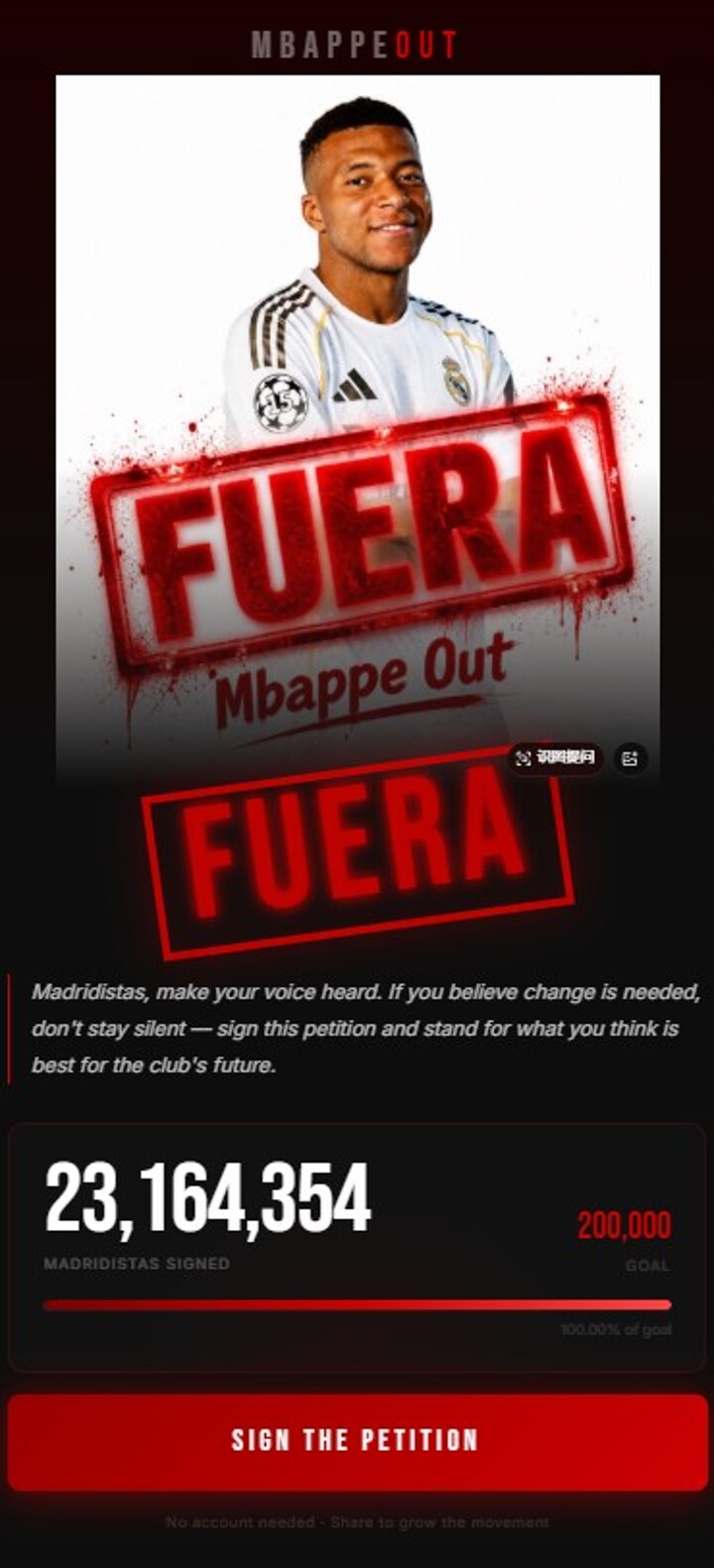
As of Beijing time (UTC+8) on May 7th, the number of petitioners has reached 23.16 million.
ArobaseGiovanny (nickname "Gio CR7"), a well-known user in the foreign social platform football community, was the first to point out the suspicious aspects of the petition website's code. The primary problem is that the rhythm of the signature growth has no changing trend.
"When I opened the website, I found that the number of signatures was growing extremely fast," he said on Wednesday afternoon. "I felt that this was very wrong. After checking the code, I discovered that the website was set to a mode of continuous signature growth." While providing screenshots to corroborate his claims, he put forward the conjecture that "there is a loop counter to falsely increase the number of signatures."
These concerns were recognized by Clément Domingo (nickname "SaxX"), a well-known hacker in the field of cybersecurity. He said that the platform is mainly "for students and developers who want to test their ideas," and it neither "verifies the identity of the creators" nor "provides review"; while well-known petition websites such as change.org have dedicated teams to combat signature fraud.
Another problem with the website is its lack of a reliable anti-counterfeiting protection mechanism. In fact, the website does not require signers to verify their email addresses, which opens the door to "bots (robot programs)." The purpose of these automated programs is to perform repetitive tasks on the Internet, such as allowing a user to sign thousands or even millions of times.
In order to verify the reliability of the petition platform, Domingo conducted a test and created a robot. "I can vote 100 times in less than a second, even my grandma can do it. Just ask the most basic AI on the market how to bypass this restriction. Everyone has been fooled, everyone has been tricked."
Domingo suggested that everyone should resolutely not sign petitions hosted on platforms like Replit. "We don't even know if they will record your IP address, metadata, computer size..."
"What will happen if this type of platform is used for topics closely related to the vital interests of citizens?" he questioned, envisioning scenarios in which such petitions could be abused, such as "false mobilization against a certain law" or "influence manipulation related to election voting."