


On July 14, local time, ahead of the FIFA World Cup semi-final between England and Argentina, L'Équipe analyzed the physical condition of Argentinian star Messi in this FIFA World Cup.
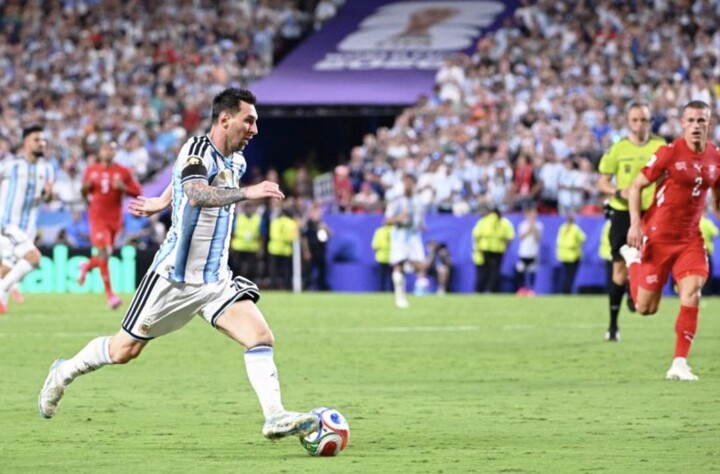
Ahead of the 2026 FIFA World Cup semi-final, Messi's form has become a focus of public attention.
He has records, goals, and astonishing technical moves.
But there's also that lean physique he still maintains, and the almost gaunt, slightly "ghostly" face at the end of matches.
Since the start of this FIFA World Cup, the physical condition displayed by the 39-year-old Messi has surprised many observers.
In the quarter-final against Switzerland (Argentina won 3-1 in extra time), due to the strong Swiss players and their very tight marking, Messi indeed found it harder than usual to create breakthroughs and make decisive impacts.
But he still persevered, playing for 120 minutes, and almost ended the game in the last moments of regular time – in the 90th minute + 2, a shot of his grazed the outside of the post, nearly helping Argentina avoid extra time.
It has been repeatedly emphasized that the Argentina captain no longer sprints as frequently as he did in his prime. He consciously schedules many "low-exertion periods" in each match, reducing his defensive tracking and high-intensity pressing.
The goal is clear: to be more efficient and precise when he truly enters an attacking state and looks for decisive opportunities. But this physical management cannot explain everything about Messi's current condition.
His personal nutritionist, Ismael Galancho, a coach specializing in sports nutrition, recently released some information about the legendary player's physical data.
Galancho pointed out, using statistics from a professional sports data company: "According to Traclab data, Messi's top speed during the 2022 FIFA World Cup was 29.38 km/h. As of now, in this FIFA World Cup, Messi's top speed has reached 30.9 km/h (according to Sofascore data), meaning his top speed has increased by over 5%."
He further explained: "Between 2009 and 2015, Messi's top speed was approximately between 32.5 and 33.5 km/h. In some individual tests, he even approached 34 km/h. But usually, a player's top speed will significantly decrease after the age of 30. Generally, between 30 and 35, players lose 1% to 2% of their speed per year; after 35, this decline typically reaches 1.5% to 3% per year."
Galancho concluded: "Messi's physical condition in this FIFA World Cup is actually better than it was in the last FIFA World Cup, despite four years having passed. What did we do to reverse his physical decline? That I cannot reveal. But seeing the final results, seeing the training, effort, and persistence Messi has put in over the years, I am very happy."
Starting from the resumption of MLS matches in February, Messi intensified his training preparations. It is certain that if Messi had not completely changed his eating habits from his early career, such an extended career longevity would have been almost impossible.
In his early career, Messi was very fond of pizza, hot dogs, red meat, and carbonated drinks. About 15 years ago, under the guidance of Italian nutritionist Giuliano Poser, he began to adopt a healthier, balanced diet.
At that time, the main reason Messi changed his diet was not to extend his career, but because of long-term recurring muscle injuries and vomiting issues caused by stomach discomfort.
Today, he lives a highly disciplined life.
Sleep, strength training, muscle activation training, he strictly adheres to them all, and has established an extremely precise daily routine that he rarely deviates from.
To be in the best condition for this FIFA World Cup, Messi also made very special preparations. During the long European season this year, some European players conserved energy by adjusting their game time. But Messi, playing for Inter Miami, chose to further intensify his training starting from the resumption of the new MLS season in late February.
Accompanied by his Inter Miami and Argentina national team teammate De Paul, Messi underwent high-intensity training to gradually reach his optimal condition before the FIFA World Cup. This was also to compensate for the inconsistent rhythm of the American professional league.
For three months, the two Argentine internationals almost underwent "double training." In addition to the team training arranged by the club, they also underwent extra individual training daily with a private fitness coach. The training primarily included strength training and high-intensity training, with the training load adjusted according to FIFA World Cup requirements. At the same time, they also tested the training results through MLS matches: in May, Messi contributed 5 goals and 7 assists; De Paul scored 2 goals and provided 2 assists.
Scaloni said: "Logically, it will all end one day. One day, he will be 50. But as long as he wants to, he will still be the best."
This is also one of Messi's most important long-term goals: he wants to be worthy of this final (perhaps final) great FIFA World Cup journey. He does not want to participate in the FIFA World Cup as a reigning champion without being fully prepared, without doing his utmost to remain competitive.
In late May, Messi experienced a physical alert. Due to excessive muscle load, he felt some pain. After a few days of rest, he readjusted his condition and entered the FIFA World Cup with confidence, believing that his body was in very good shape.
AF's PC site is now live! Browse full news, comments, match details and stats on your computer. Visit: www.allfootballapp.com